It refers to Srimati Radhika, who is the Giver of the Salvation.
Uncategorized
Murari Preyasi Vrindavanesvari
It refers to Vrindavanesvari, who is the Beloved of Lord Murari.
Murari Preyasi Nagnajiti
It refers to Nagnajiti, who is the Beloved of Lord Murari.
Mukunda Priya Mitravinda
It refers to Mitravinda, who is dear to Lord Mukunda.
Mukunda Priya Radha
It refers to Srimati Radha, who is dear to Lord Mukunda.
Dwarkadhish Priya Devaki
It refers to Devaki, who is dear to Lord Dwarkadhish.
Manakarsini Radhika
It refers to Srimati Radhika, who attracts the minds of everyone.
Maha Dayamayi Vrajesvari
It refers to Vrajesvari, who is extremely merciful.
Mahasundara Chaitanya
It refers to Lord Chaitanya, who is extremely beautiful.
Mahabandhu Gauranga
It refers to Lord Gauranga, who is the greatest friend.
Govinda sangini Vrindavanesvari
It refers to Vrindavanesvari, who accompanies Lord Govinda.
Lilesvari Radharani
It refers to Srimati Radharani, who is the Goddess/Queen of pastimes.
Lilamayi Yamuna
It refers to Yamuna devi, who loves to perform many pastimes.
Lalita Priya Gandharvika
It refers to Gandharvika, who is dear to Lalita devi.
Lalita Priya Gopika
It refers to Gopika, who is dear to Lalita devi.
Lalita Priya Vrajesvara
It refers to Lord Vrajesvara, who is dear to Lalita devi.
Lalita Priya Vrajesa
It refers to Lord Vrajesa, who is dear to Lalita devi.
Shyamasundara Vallabhi Gaurangi
It refers to Gaurangi, who is Lord Shyamasundara’s beloved.
Shyamasundara Vallabhi Gopika
It refers to Gopika, who is Lord Shyamasundara’s beloved.
Shyamasundara Vallabhi Hemangi
It refers to Hemangi, who is Lord Shyamasundara’s beloved.
Gaura Kathamrita
It refers to the nectar of the stories of the pastimes of Lord Gaura.
Kunja Vilasini Vrindavanesvari
It refers to Vrindavanesvari, who sports in the groves of Vrindavana.
Krishna Bandhu Subala
It refers to Subala who is the friend of Lord Krishna.
Rasabihari priya Vishakha
It refers to Vishakha devi, who is dear to Lord Rasabihari.
Gaurangi priya Madana Mohana
It refers to Lord Madana Mohana, who is dear to Gaurangi.
Golokesvara priya Sudevi
It refers to Sudevi, who is dear to Golokesvara.
Golokesvara priya Rangadevi
It refers to Rangadevi, who is dear to Golokesvara.
Krpa Sagara Vraja Sundara
It refers to Lord Vraja Sundara, who is an ocean of mercy.
Krpa Sagara Shyamasundara
It refers to Lord Shyamasundara, who is an ocean of mercy.
Komalanga Murari
It refers to Lord Murari, whose limbs are Komala (delicate).
Komalanga Hrsikesa
It refers to Lord Hrsikesa, whose limbs are Komala (delicate).
Gokula Jana Priya Hari
It refers to Lord Hari, who is dear to the residents of Gokula.
Harinama diksha

Within The Gaudiya Vaishnava Sampradaya, there are two initiations given to the aspiring devotee. The first is the Hari Nama diksha. This is when the spiritual master carefully observes the sincerity of the disciple, traditionally for at least one year. The disciple has to chant the holy name of the Lord with a regular discipline according to particular vow and follow four regulative principles, i.e. no illicit sex, no intoxication, no gambling, and no meat eating.
When the spiritual master sees that the disciple is following these vows and also has assumed the consciousness of obedience to the Guru, obedience in service of the Guru, then the spiritual master awards the Hari Nama initiation. At this point, the disciple vows to chant 16 rounds of the Hare Krishna Mahamantra daily and also to follow the four regulative principles. The Spiritual Master Gives a spiritual names to His disciple, thus spiritualizing His existence. Thus, a formal link between the Guru and the disciple is established. The disciple is then eternally connected to the disciplic succession of all previous Acharys and Vaishnavas. In this way, He becomes a part of this family, the spiritual family.
The second initiation is the brahmin initiation. When one takes this initiation, He is not given another spiritual name. For being eligible for this initiation, one has to have taken the Hari Nama diksha. During the brahmin initiation, the Devotee is given the sacred brahmin thread by his spiritual master and spiritual master chants the Gayatri Mantra in the right ear of the disciple. When one takes the Brahmin initiation there is great responsibility upon the disciple. Srila Prabhupada expected His Brahmin disciples to exhibit in their behavior as well as in their words the true qualities of a Vaishnav Brahmin. That means by their example and by their words, they teach to the human society the path Back Home Back to Godhead.
Goddess Lakshmi

Lakshmi is the Hindu Goddess who governs all forms of wealth and success and the paths, means and results to all forms of Prosperity. She is the consort of the Lord Vishnu. Lakshmi Devi is the Goddess of Health and Beauty. Sri Lakshmi embodies Sublime Beauty, Siddhi, Peace, Strength, Balance, Auspiciousness, Opulance and Wisdom. Because Lakshmi possesses all of these good and noble qualities, She embodies infinite wealth symbolizing that good and noble qualities are the only wealth we can keep.
Lakshmi Devi is always depicted sitting or standing on a lotus with golden coins flowing in an endless stream from one of her hands symbolic of when the lotus of wisdom blossoms, the wealth of good and noble qualities appears and Lakshmi’s blessings are present.
Mother Lakshmi is the One who bestows the 16 types of wealth:(1) Fame; (2) Knowledge; (3) Courage and Strength; (4) Victory; (5) Good Children; (6) Valor; (7) Gold, Gems and Other Valuables; (8) Grains in abundance; (9) Happiness; (10) Bliss; (11) Intelligence; (12) Beauty; (13) Higher Aim, High Thinking and Higher Meditation; (14) Morality and Ethics; (15) Good Health; (16) Long Life.
Appearance of Goddess Lakshmi:
Goddess Lakshmi, The Goddess of Fortune appeared during the churning of the Ocean of Milk. As the next result of the churning, many things emerged from the ocean, such as Airavata, two celebrated gems-Kaustubha-mani and Padmaraga-mani, Apsaras, etc. After the Apsaras, Goddess Lakshmi appeared. She appeared like electricity, surpassing the lightning that might illuminate a marble mountain. Due to her exquisite beauty, her bodily features, her youth, her complexion and her glories, everyone, including the demigods, the demons and the human beings, desired her. They were attracted because she is the source of all opulences. After been properly celebrated with an auspicious ritualistic ceremony, She began moving about, holding in her hand a garland of lotus flowers, which were surrounded by humming bumblebees. Smiling with shyness, her cheeks decorated by her earrings, she looked extremely beautiful. Approaching the Supreme Personality of Godhead, the goddess of fortune placed upon His shoulders the garland of newly grown lotus flowers. In this way, Goddess Lakshmi appeared.
Ashta Lakshmi

Lakshmi Devi has 8 primary forms. These 8 forms are personified as Ashta Lakshmi (Ashtalakshmi). These eight forms are as follows:
(1) Adilakshmi: Mother Lakshmi resides with Lord Narayana in Vaikuntha, the abode of Lord Narayana. She is known as Rama, which means "bringing happiness to the mankind". She is also known as Indira (who holds lotus or purity). In this form, Lakshmi is normally seen serving Sri Narayana. Adi Lakshmi or Rama Lakshmi serving Sri Narayana is symbolic of her serving the whole creation. Adi Lakshmi and Narayana are not two different entities but one only. Lakshmi is Shakti. Lakshmi is the Power of Narayana.
(2) Dhanyalakshmi: Dhanya means grains. Lakshmi is the Goddess of the Harvest and the Devi who blesses with abundance and success in harvest.
(3) Dhairyalakshmi: This form of mother Lakshmi grants the boon of infinite courage and strength. Those, who are in tune with infinite inner power, are always bound to have victory. Those who worship mother Dhairya Lakshmi lead a life with tremendous patience and inner stability.
(4) Gajalakshmi: In the holy book of Srimad Bhagavata the story of the churning of the ocean by Gods and demons is explained in detail. Sage Vyasa writes that Lakshmi came out of the ocean during the churning of the ocean (Samudra Manthan). So she is known as a daughter of the ocean. She came out of the ocean sitting on a full-bloomed lotus and also having lotus flowers in both hands with two elephants by her sides holding beautiful vessels.
(5)Santanlakshmi: In the family life, the children are the greatest treasure. Those who worship this particular form of Sri Lakshmi, known as a Santan Lakshmi, are bestowed with the grace of mother Lakshmi and have wealth in the form of desirable children with good health and a long life.
(6) Vijaylakshmi: Vijay is victory. Vijay is to get success in all undertakings and all different facets of life. Vijay is to conquer the lower nature. Hence those, with grace of mother Vijay Lakshmi, have victory everywhere, at all time, in all conditions.
(7) Dhanalakshmi: Dhana is wealth. Wealth comes in many forms: Nature, Love, Peace, Health, Prosperity, Luck, Virtues, Family, Food, Land, Water, Will Power, Intellect, Character, etc. With the grace of mother Dhana Lakshmi we will get all these in abundance.
(8) Vidyalakshmi: Vidya is education. Serenity, Regularity, Absence of Vanity, Sincerity, Simplicity, Veracity, Equanimity, Fixity, Non-irritability, Adaptability Humility, Tenacity, Integrity, Nobility, Magnanimity, Charity, Generosity and Purity are the eighteen qualities imbibed through proper education that only can give immortality.
Lord Ganesha

The joyous elephant-faced deity known as Ganesha is revered by one billion hindus worldwide. Ganesha is often seen as the remover of obstacles, as the guardian at entrances and as a spiritually potent figure who can avert all evil influences. He is the god to be worshiped first, before all religious ceremonies, public and private. Ganesha is a popular hero whose image adorns the walls of shops, homes, and temples throughout India. Even for people unfamiliar with Indian culture or the Vedic literature, Ganesha is perhaps the easiest of all demigods to identify, with his human body, elephant head, and potbelly.
He is usually pictured standing, sitting, or dancing, with his jolly elephant face looking straight ahead. Ganesha is at times depicted with quill on palm leaf, for as Vyasa dictated the Mahabharata, Ganesha served as the scribe to write it down. Sometimes he is depicted with one tusk missing, a piece of which can sometimes be found in one of his four hands. In another hand he sometimes holds a hatchet (parasu), which, according to some texts, is for cutting away illusion and false teachings. Another of Ganesha's hands often gestures fearlessness and reassurance (varada-hasta-mudra). He also holds a goad (ankusa), like that used by an elephant trainer, symbolizing his insistence on proper training or spiritual discipline. He sometimes holds a noose (pasa) used for restraining wild animals, here representing the restraint of passion and lustful desires. Sometimes he is seen holding sweets (modaka), for which he is said to have an inordinate fondness.
Vedic texts reveal that Ganesha is the son of Shiva and Parvati. The story of His birth is quite peculiar. Once, Parvati, wanting to seclude herself from her passionate husband, Shiva, especially while bathing, creates a son from her perspiration and appoints him the guardian of her quarters. Soon after, when Shiva seeks admission into Parvati's inner chambers, Ganesha, unaware of Shiva's identity, refuses him, pushing him away from Parvati's door. Enraged, Lord Shiva summons his attendants (ganas) to do away with this bothersome upstart. But Ganesha defeats them one by one. Finally Vishnu arrives, and drawing upon His maya (mystic potency) He creates confusion on all sides. This enables Shiva to cut off Ganesha's head.
Parvati, furious at what has become of her "son," decides to send a multitude of goddesses to harass the demigods. These celestial women succeed in making it clear to the noble gods that their queen can be appeased only if her guardian is revived. Shiva then tells the gods to go north and cut off the head of the first living being they see. The head is to be mystically placed on the body of the decapitated Ganesha, who will then come back to external consciousness. As fate would have it, the first living being to cross the path of the gods is an elephant.
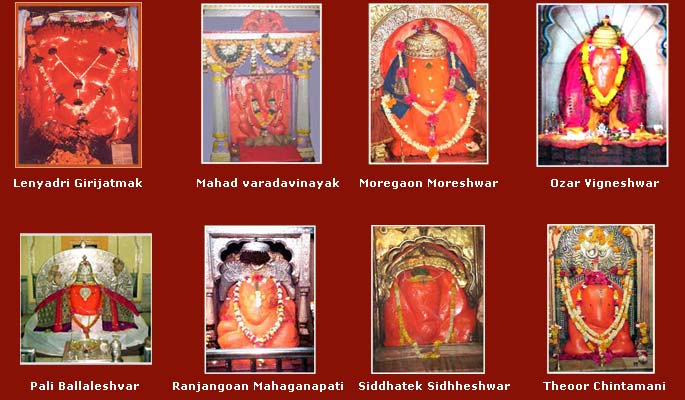
Photo of Ashta Vinayaka (eight forms of Lord Ganesha)
Lord Shiva

The Birth of Lord Shiva:
The pastime of Lord Shiva's birth is described in Srimad-Bhagavatam (3.12.7-13): "Although Brahma tried to curb his anger, it came oaut from between his eyebrows, and a child of mixed blue and red was immediately generated. After his [Shiva's] birth, he began to cry: "O destiny maker [Brahma], teacher of the universe, kindly designate my name and place.". The all-powerful Brahma, born from the lotus flower, pacified the boy with gentle words, accepting his request, and said: Do not cry. I shall certainly do as you desire. Thereafter, Brahma said: "O chief of the demigods, you shall be called by the name Rudra by all people because you have anxiously cried. My dear boy, I have already selected the following places for your residence: the heart, the senses, the air of life, the sky, the air, the fire, the water, the earth, the sun, the moon, and austerity. My dear Rudra, you have eleven other names: Manyu, Manu, Mahinasa, Mahan, Shiva, Atadhvaja, Ugrareta, Bhava, Kala, Vamadeva, and Dhrtavrata. You also have eleven wives, called the Rudranis, and they are as follows: Dhi, Dhrti, Rasala, Uma, Niyut, Sarpi, Ila, Ambika, Iravati, Svadha, and Diksa.
General Information:
Shiva is among the most widely worshiped deities in India. With names such as Mahadeva ("the great god") and Nataraja ("the king of dancers"), he is venerated in ancient holy cities like Benares, where Saivites (as his worshipers are called) devote their lives to him, viewing him as the Supreme Lord. The fact is, He is supreme. As the scriptures say, "Srimad-Bhagavatam is supreme among Puranas just as the Ganga is the greatest of all rivers, Lord Acyuta [Visnu] the best among deities, and Lord Sambhu [Shiva] the greatest among devotees of Lord Vishnu [vaisnavanam yatha sambhu]." (Srimad-Bhagavatam 12.13.16) According to this and similar statements, Shiva may correctly be considered the greatest at least among devotees but among gods the supreme is Vishnu. Shiva is superior to Brahma, who is an empowered soul (jiva), but Shiva is not quite on the same level as Visnu. It is therefore said that Shiva is a unique living being who merits his own category, known as Shiva-tattva.
Lord Shiva, the best of the demigods :
Lord Shiva, also called Rudra, is the demigod in charge of the material mode of ignorance (tamo-guna), and he is in charge of destruction. He is worshiped by persons who are influenced by ignorance, and he supervises their activities.
ananta brahmande rudra sadasivera amsa
gunavatara tenho, sarva-deva-avatamsa
“Rudra, who is an expansion of Sadashiva and who appears in unlimited universes, is also a gunavatara [qualitative incarnation] and is the ornament of all the demigods in the endless universes.” (Cc. Adi 6.79)
Thus, Lord Shiva is a demigod, albeit the best of them. Yet he also has another feature: He is a pure devotee of the Supreme Lord and the service and worship of pure devotees of Lord Krishna is most highly recommended for everyone:
yat-sevaya bhagavatah
kuta-sthasya madhu-dvisah
rati-raso bhavet tivrah
padayor vyasanardanah
“The service of the feet of pure devotees vanquishes one’s material distresses and enables one to develop transcendental ecstasy in the service of the Personality of Godhead, the unchangeable enemy of the Madhu demon.” (SB 3.7.19)

A Photo of the 12 Jyotirlingas
Goddess Durga

In India "the Goddess" is known by the names such as Durga, Kali, Amba, etc. and whether referred to by her Greek name, Gaia, her African name, Ashun, her Egyptian name, Isis, or any of the hundreds of names by which she is known throughout the world, the Goddess is enjoying great popularity today everywhere, especially in the United States and Europe.The popularity of the Goddess is understandable. The material world is her domain, her jurisdiction given to her by Krishna.
The Brahma-samhita (5.43), one of the oldest scriptures known to man, describes four levels of existence: The highest is Krishna's own abode, the kingdom of God in its most profound manifestation; just below that is Hari-dhama, the place of the other spiritual planets; lower still is Mahesa-dhama, the dwelling place of Shiva and his devotees; and finally there is Devi-dhama, the material world, where the Mother of the Universe, the Goddess, controls the living entities who have chosen to try to enjoy separately from Krishna. Devi-dhama consists of fourteen planetary systems, from the lowest planet in the material world to the highest. The Supreme Lord's external potency, who is the shadow of His knowledge potency, is worshiped by all people as Durga, the creating, preserving, and destroying agent of this mundane world.
When people in India speak of Devi, "the Goddess," they generally mean Durga, who creates, maintains, and destroys within the material sphere. Durga is elaborately described in many of the Vedic books known as Upa-puranas, or "lesser Puranas," particularly in the Devi Bhagavata Purana. As the consort of Shiva, she is known as Parvati, Gauri, Uma, Devi, and Bhavani. She has thousands of other names and forms as well. Durga's characteristics are diverse, and they appear differently according to the aspect on which her worshiper chooses to focus. Gauri, Uma, and Parvati are the most benevolent, often portrayed as loving and kind. Durga is often represented as a heroic fighting goddess and to people who don't know the purpose behind her actions, she or her alter ego Kali may sometimes even seem bloodthirsty.
Durga is also identified with prakrti (material nature) and maya (illusion). Indeed, two of her more popular names are Mulaprakrti ("The Embodiment of Primordial Matter") and Mahamaya ("The Great Illusion"). In Bhagavad-gita (9.10) Krishna says, mayadhyaksena prakrtih suyate sa-caracaram: "The material energy [prakrti] is working under My direction, O son of Kunti, and is producing all moving and unmoving beings." Prakrti is Durga. So Krishna is in control, giving direction to Durga, His subordinate. And when one doesn't acknowledge that, Durga becomes Mahamaya she places us under illusion.

A photo of the Nine Forms of Goddess Durga
Servants of Lord Krishna
1) Most prominent servants of Lord Krsna:
(These servants carry Krishna's venu and murali flutes, buffalo-horn bugle, stick, rope and other paraphernalia.)
| 01. Bhangura | 02. Brngara | 03. Sandhika | 04. Grahila |
| 05. Raktaka | 06. Patraka | 07. Patri | 08. Madhukantha |
| 09. Madhuvrata | 10. Salika | 11. Talika | 12. Mali |
| 13. Mana | 14. Maladhara |
2) Betel nut Servants of Lord Krsna:
| 01. Pallva | 02. Mangala | 03. Phulla | 04. Komala |
| 05. Kapila | 06. Suvilasa | 07. Vilasaksa | 08. Rasala |
| 09. Rasasali | 10. Jambula |
3) Servants Who Provide Aromatic Substances:
| 01. Sumanah | 02. Kusumollasa | 03. Puspahara | 04. Hara |
4) Decorators:
| 01. Premakanda | 02. Mahagandha | 03. Sairindhra | 04. Madhu |
| 05. Kandala | 06. Makaranda |
5) Maidservants of Lord Krsna:
| 01. Dhanistha | 02. Candanakala | 03. Gunamala | 04. Ratiprabha |
| 05. Taruni | 06. Induprabha | 07. Sobha | 08. Rambha |
| 09. Kurangi | 10. Bhrngari | 11. Sulamba | 12. Alambika |
6) Spies of Lord Krsna:
| 01. Catura | 02. Carana | 03. Dhiman | 04. Pesala |
7) Gopa Messengers of Lord Krsna:
| 01. Visarada | 02. Tunga | 03. Vavaduka | 04. Manorama |
| 05. Nitisara |
8) Gopi Messengers of Lord Krsna:
| 01. Paurnamasi | 02. Vira | 03. Vrinda | 04. Vamsi |
| 05. Nandimukhi | 06.Vrindarika | 07. Mela | 08. Murali |
9) Other servants:
Payoda and Varida are the most important of the servants engaged in carrying water for Lord Krishna.
Saranga, Sumukha, Durlabha, Ranjana and Bakula are the most important of the servants engaged in expertly washing Lord Krishna's laundry.
Vimala and Komala are engaged in various services such as caring for the Lord's kitchen.
Svaccha, Susila and Praguna are engaged in various services, such as caring for the Lord's hair, massaging Him, giving Him a mirror and
guarding over His treasury.
Sobhana and Dipana provide lamps for the Lord.
Sudhakara Sudhanada and Sananda play the mrdanga for Krishna's satisfaction.
Vicitrarava and Madhurarava are the leaders of the talented an virtuous poets who compose prayers glorifying Sri Krishna, while Candrahasa,
Induhasa and Candramukha are leaders of the servants who dance for the Lord's satisfaction.
Kalakantha, Sukantha, Sudhakantha, Bharata, Sarada, Vidyavilasa, Sarasa and others are learned in the arts of all kinds of literary composition.
Raucika is the tailor who sews clothes for the Lord.
Punyapunja and Bhagyarasi are the two sweepers who clean the area around Krishna's home.
Rangana and Tankana are goldsmiths who make ornaments for the Lord. Pavana and Karmatha are potters who make drinking vessels and jugs for
churning butter.
Vardhaki and Vardhamana are carpenters who serve the Lord by building carts, couches and other objects. Sucitra nd Vicitra are talented artists
who paint pictures for the Lord.
Kunda, Kanthola and Karanda are craftsmen who make ropes, churning rods, axes, baskets, balances for carrying heavy objects and various other
ordinary utensils.
Associates of Yashoda
|
01. Vatsala |
15. Dhamanidhara |
|
02. Kusala |
16. Paksati |
|
03. Tali |
17. Pundi |
|
04. Medura |
18. Sutunda |
|
05. Krpa |
19. Tusti |
|
06. Sankini |
20. Anjana |
|
07. Bimbini |
21. Tarangaksi |
|
08. Mitra |
22. Taralika |
|
09. Subhaga |
23. Subhada |
|
10. Bhogini |
24. Mallika |
|
11. Prabha |
25. Angada |
|
12. Sarika |
26. Sallaki |
|
13. Niti |
27. Vena |
|
14. Kapila |
28. Vartika |
Along with these associates, Yashoda devi had two dear friends – Ambika and Kilimba. Ambika and Kilimba are the two nurses who fed Krishna with their breast milk.