A name of Lord Rama, which means “The brave one in The Raghu dynasty”.
Monthly Archives: May 2012
Raghuvarya
Raghuvarya Tirtha, an acarya in succession from Srila Madhvacarya.
Raghupati Raghava
Raghupati Prana
It means the one who is the life of Raghupati.
Raghupati
A name of Lord Rama, which means “The Lord of The people of the Raghu dynasty”.
Raghunatha Carana
It means the lotus feet of Lord Raghunatha( Lord Rama).
Raghunatha Bhatta
He was the son of Tapan Mishra. He later became Raghunatha Bhatta Goswami.
Raghunatha
A name of Lord Rama, which means “He is the Lord of (the people of) the Raghu dynasty”.
Raghunath Puri
The former name of Acarya Vaishnavananda, who belonged to the sakha of Lord Nityananda.
Raghunath Priya
It means the one who is dear to Raghunath(Lord Rama).
Raghunath Prana
It means the one who is the life of Raghunatha.
Raghunath Bhatta
Raghunath Bhatta was the son of Tapana Mishra. He is one of the six Goswamis of Vrindavan.
Raghunandana
A name of Lord Rama, which means “He is a son in the Raghu dynasty”.
Raghumishra
He was the twenty third branch of Gadadhara Pandit and was Karpura-manjari in Vrajalila.
Raghu
A great King, in his dynasty Lord Rama appeared.
Raghavesa
A name of Lord Rama.
Raghavendra
A disiciple of Narottama Dasa Thakura. A name of Lord Rama.
Raghavananda
One who provides happiness to Raghava(Lord Rama).
Raghava Pandita
Shri Raghava Pandita was Dhanishta in Krishna lila. He was a dear associate of Lord Chaitanya as well as Lord Nityananda. He was a resident of Panihati.
Raghava Caitanya
A guru in Maharashtra who had come in contact with the saint Tukarama.
Raghava
A name of Lord Rama, which indicates that He belongs to the Raghava dynasty.
Raganuga Bhakti
It means spontaneous devotional service. It is also known as ragatmika bhakti.
Raganuga
Persons desiring to follow in the footsteps of eternal devotees of the Lord as the Vrishnis and Vrindavana denizens are called raganuga devotees, which means that they are trying to attain to the perfection of those devotees. These raganuga devotees do not follow the regulative principles of devotional service very strictly, but by spontaneous nature they become attracted to some of the eternal devotees such as Nanda or Yashoda, and they try to follow in their footsteps spontaneously.
Srimati Sudevi

Sudevi is the eighth of the ashta sakhis (eight topmost sakhis). She is sweet and charming by nature. She is the sister of Rangadevi. Her husband is Vakreksana, the younger brother of Bhairava. Her marriage with Vakreksana was arranged by his younger brother. Her form and other qualities are so similar to those of her sister Rangadevi that they are often mistaken for one another. Sudevi always remains at the side of her dear friend Srimati Radharani. Sudevi arranges Radharani's hair, decorates Her eyes with mascara and massages Her body.
She is expert in training male and female parrots and she is also expert in the pastimes of roosters. She is an expert sailor and She is fully aware of the auspicious and inauspicious omens described in the Sakuna-sastra. She is expert at massaging the body with scented oils, she knows how to start fires and keep them burning and she knows which flowers blossom with the rising of the moon.friends of Sudevi are expert at constructing leaf-spitoons, playing music on bells and decorating couches in various ways.
Sudevi's friends are entrusted with the decoration of the Divine couple's sitting place. Sudevi's friends act as clever spies, disguising themselves in various ways and moving among Radharani's rivals (Candravali and her friends) to discover their secrets. Sudevi's friends are the deities of Vrindavana forest and they are charged with the protection of the forest birds and bees. Sudevi is the leader of these gopis. her Seva is to bring water. Her age is 14 years, 2 months and 4 days.In gaura-lila she appeared as Sri Vasudeva Ghosh.
The chief sakhis in Sri Sudevi’s group are Kaveri, Carukavari, Sukesi, Manjukesika, Harahira, Harakanti, Haravalli and Manohara.
Srimati Rangadevi

Rangadevi is the seventh of the ashta sakhis (eight topmost sakhis). Her complexion is the color of a lotus filament and her garments are the color of a red rose. She is seven days younger than Srimati Radharani. Her personal qualities are much like those of Campakalata. Her parents are Karuna-devi and Rangasara.
Ranga-devi is always like a great ocean of coquettish words and gestures. She is very fond of joking with her friend Srimati Radharani in the presence of Lord Krishna. Among the six activities of diplomacy she is especially expert in the fourth: patiently waiting for the enemy to make the next move. She is an expert logician and because of previous austerities she has attained a mantra by which she can attract Lord Krishna.
Ranga-devi's friends are expert at burning aromatic incense, carrying coal during the winter and fanning the divine couple in the summer.Ranga-devi's friends are able to control the lions, deer and other wild animals in the forest. Ranga-devi is the leader of all these gopis. Her seva is offering candana. Her home is in Yavata, and her age is 14 years, 2 months and 4 1/2 days. In Kali-yuga she appears in gaura-lila as Gadadhara Bhatta.
The chief sakhis in Sri Rangadevi’s group are Kalakanti, Sasikala, Kamala, Prema Manjari, Madhavi, Madhura, Kamalata and Kandarpa-sundari.
Radharadhya
Radhapati
Radhanatha
Srimati Indulekha Devi
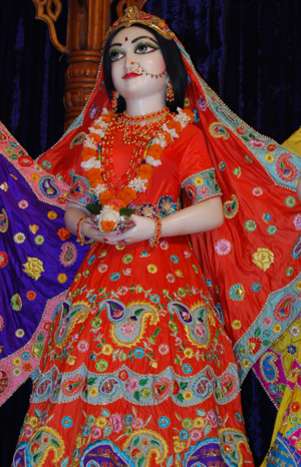
Indulekha is the sixth of the ashta sakhis (eight topmost gopis). She has a tan complexion and wears garments whose colour is like that of a pomegranate flower. She is three days younger than Srimati Radharani. Her parents are Sagara and Vela devi and her husband is Durbala. She is contrary and hot-tempered by nature. Noble Indulekha is learned in the science and mantras of the Naga-sastra, which describes various methods of charming snakes. She is also learned in the Samudraka-sastra, which describes the science of palmistry. In her hand she carries the auspicious messages of the divine couple. In this way She creates the good fortune of Radha and Krishna by creating Their mutual love and attraction.
Indulekha-devi is fully aware of the confidential secrets of the divine couple. Some of her friends are engaged in providing ornaments for the divine couple, others provide exquisite garments and others guard the divine couple's treasury. Indulekha-devi is the leader of all these gopis. Her age is 14 years, 2 months and 10 1/2 days. Her principal seva is fanning The Divine Couple with a camara. In Gaura lila she appears as Vasu Ramananda.
The chief sakhis in Indulekha's group are Tungabhadra, Citralekha, Surangi, Rangavatika, Mangala, Suvicitrangi, Modini and Madana.
Srimati Tungavidya devi
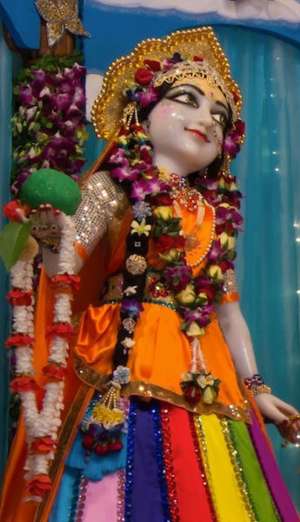
Tungavidya is the fifth of the ashta sakhis (eight topmost sakhis). Her complexion is the colour of kunkuma and the fragrance of her body is like sandalwood mixed with camphor. She is fifteen days younger than Srimati Radharani. Tungavidya is hot-tempered and expert at dissimulation. She wears white garments. Her parents are Puskara and Medha-devi and her husband is Balisa. She has full faith in Krishna. She is very expert at arranging the meeting of the divine couple. She is learned in rasa-sastra (transcendental mellows), niti-sastra (morality), dancing, drama, literature and all other arts and sciences.
She is a celebrated music teacher expert at playing the vina and singing in the style known as marga. Tungavidya is the leader of those gopis who are especially engaged in fetching water from the streams in Vrndavana.She is very devoted to her seva (service) of dancing and singing, etc. Her age is 14 years, 2 months and 22 days. In gaura-lila she appears as Sri Prabodhananda Sarasvati Thakura. It is also said that She appears as Vidya Vachaspati.
Some of the sakhis in Tungavidya’s group are Manjumedha, Sumadhura, Sumadhya, Madhureksana, Tanumadhya, Madhusyanda, Gunacuda and Varangada.
Rasa Sukha
It means the one who derives pleasure from rasas(mellows).
Rasa Sthali
It refers to the place where Lord Krishna used to have his Rasa Lila.
Rasa Parayana
Lord Krishna is Rasa Parayana, which means “The one who likes to enjoy the rasa dance”.
Rasa Murti
It refers to Lord Krishna, which means that he is the embodiment of rasas(mellows).
Rasa Mandala
It refers to the place where Lord Krishna used to have his Rasa Lila.
Ranti Dev
A generous King.
Ranjita
It means the one who is adorned.
Rangeshwar
There is a temple of Rangeshwar Mahadeva in Mathura.
Ranga-ranjana
A name of Lord Balarama.
Ranga Puri
One of the disciples of Sri Madhavendra Puri.